Gaia Research
Context Diet — Lab 001 / Benchmark 001
Compacting an oversized agent-context file without losing a rule.
A Gaia Research lab. Method, results, and reproduction protocol.
Abstract
Claude Code warns past 40,000 characters of CLAUDE.md and may truncate beyond it,
silently disabling whatever rules fall past the cutoff. The target file — gaia-skill-tree’s
CLAUDE.md — was 49,687 chars, ~24% over the limit. Naïvely trimming is unsafe: most of the
file is incident-codified guardrails, and dropping any one lets an agent ship a CI-breaking state.
We treated compaction as a two-objective problem — maximize size reduction subject to 100% rule faithfulness — and ran a four-strategy bake-off scored by an adversarial auditor against a ground-truth rule inventory. The winning strategy (Externalize + link) brought the file to 29,040 chars (−41.6%, ~5,161 tokens saved) with 100% of rules retained and zero load-bearing losses. All artifacts, charts, and the exact workflow script are preserved for replay.
1. Setup
| Target file | gaia-skill-tree/CLAUDE.md |
| Harness limit | 40,000 chars (Claude Code) |
| Baseline size | 49,687 chars (~12,421 tok), 36 sections |
| Soft target | 34,000 chars (limit − 6k headroom) |
| Rule inventory | 124 atomic rules (see §4 on the extraction-artifact correction) |
| Model | Claude Opus (all agents), high reasoning effort |
| Orchestration | Claude Code dynamic workflow, 4 strategies × (compact → adversarial verify) |
Char count is authoritative — the harness limit is defined in characters; tiktoken is not assumed present. Approximate tokens are reported as chars/4.
2. Result headline
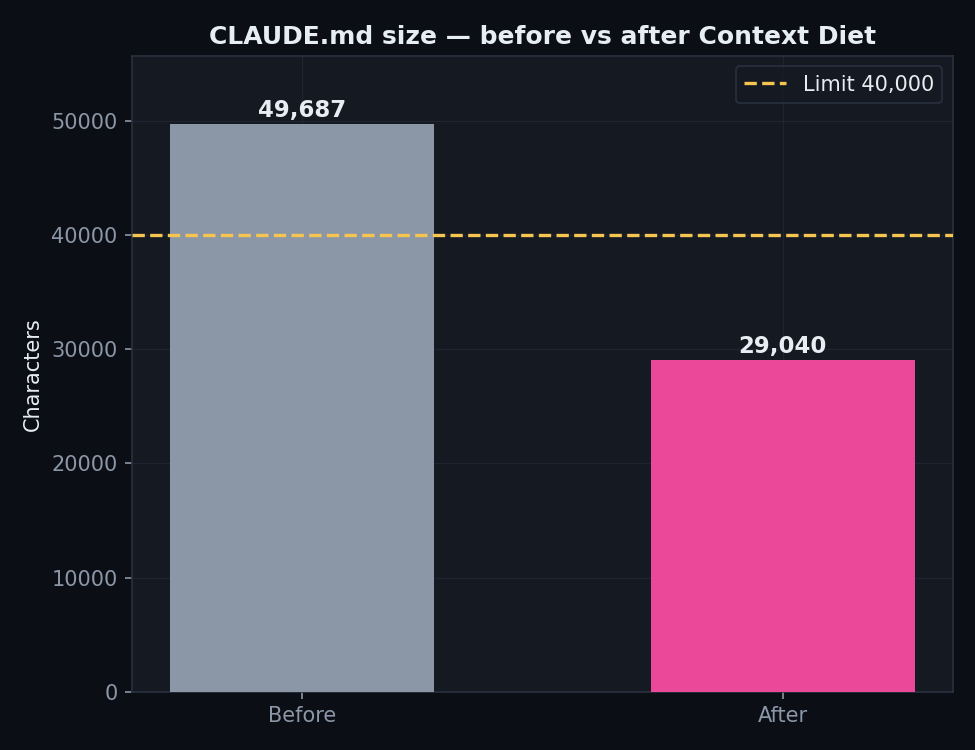
- Before: 49,687 chars — 9,687 over the 40k limit.
- After: 29,040 chars — 10,960 under the limit.
- Reduction: 20,647 chars (−41.6%), ~5,161 tokens.
- Faithfulness: 100% — every one of the 124 real rules recoverable (inline or in a linked file); 0 load-bearing rules lost.
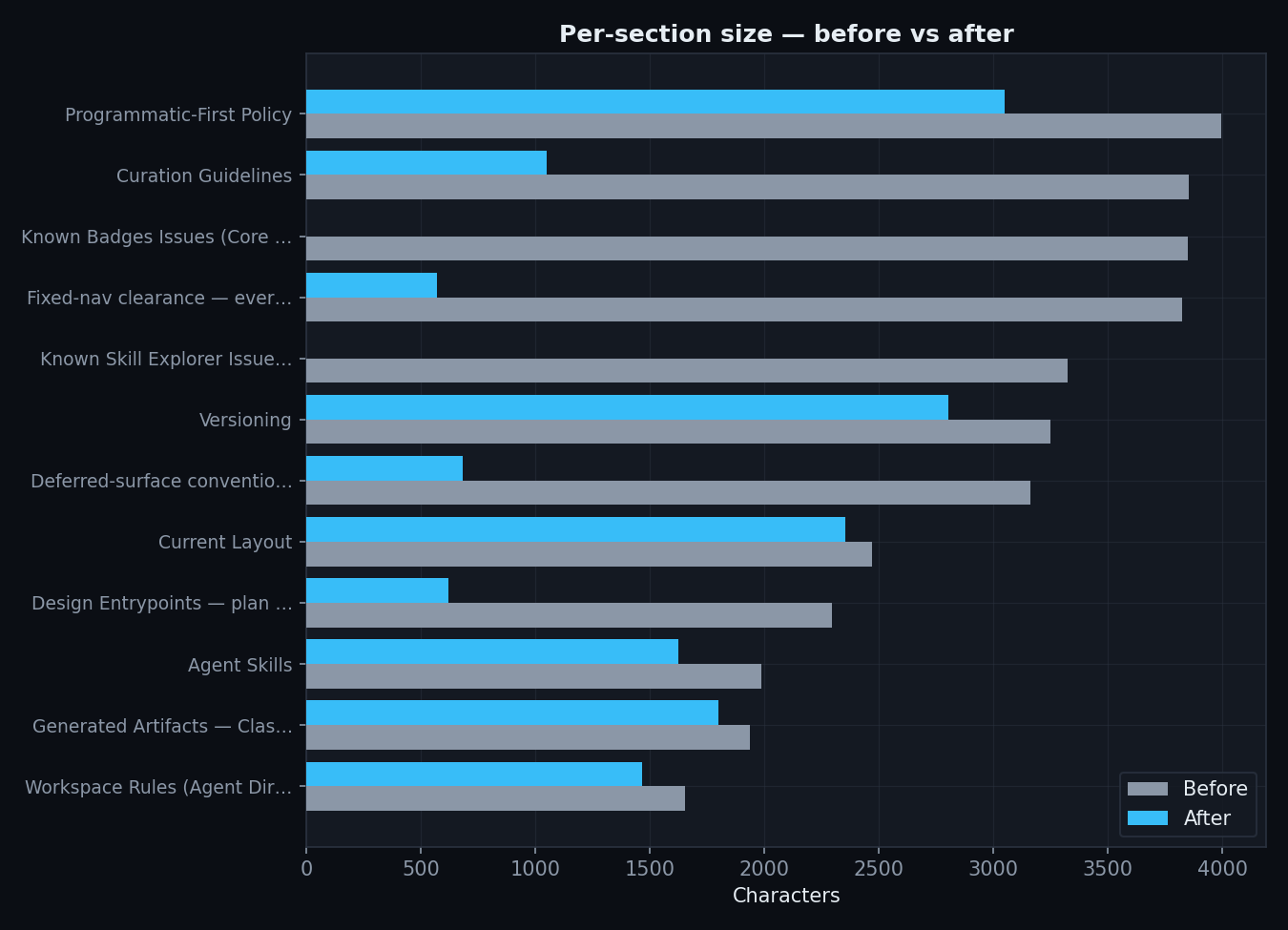
The winning method moved the five largest how-to playbooks out of CLAUDE.md into
docs/agents/*.md reference files, leaving a short stub in CLAUDE.md for each (the one-sentence
load-bearing invariant plus a See docs/agents/<file>.md pointer). Every CI-enforced section
(Redaction Exemptions and the 8 exempt handles, all Branch Scope allowlists, Programmatic-First +
CLI Pre-Flight, the Verifier Guardrail, Class P vs Class S, the Versioning decorative-asset hard
rule) stayed fully inline and verbatim.
3. The five Benchmark 001 metrics
| Metric | Result | How measured |
|---|---|---|
| Token reduction | −20,647 chars / −41.6% (~5,161 tok) | context_diet.py --json, exact char delta |
| Faithfulness retained | 100% (124/124 rules; 0 load-bearing lost) | adversarial auditor vs ground-truth inventory |
| Latency saved | ~5.2k fewer tokens read per turn that loads CLAUDE.md (method-level estimate, proportional to token reduction) |
proportional to token reduction |
| Cost saved | ~$0.077 per turn at $15/M input tokens → ~$77 per 1,000 turns (Opus input-rate estimate) | tokens saved × input rate |
| Export validity | valid GFM, 33 headings intact, all docs/agents/* links resolve to on-disk files |
context_diet.py re-parse + structural check |
Latency and cost are method-level estimates: the file is read into context on turns that load it, so the saving scales with how often that happens, not once.
4. The bake-off
Four strategies each produced a proposed rewrite (the live file was never touched during the
experiment), then an adversarial auditor — prompted to find dropped rules, defaulting to
“missing” under doubt — classified every inventory rule as present / weakened / missing against
each candidate’s full corpus (its CLAUDE.md plus any linked files).
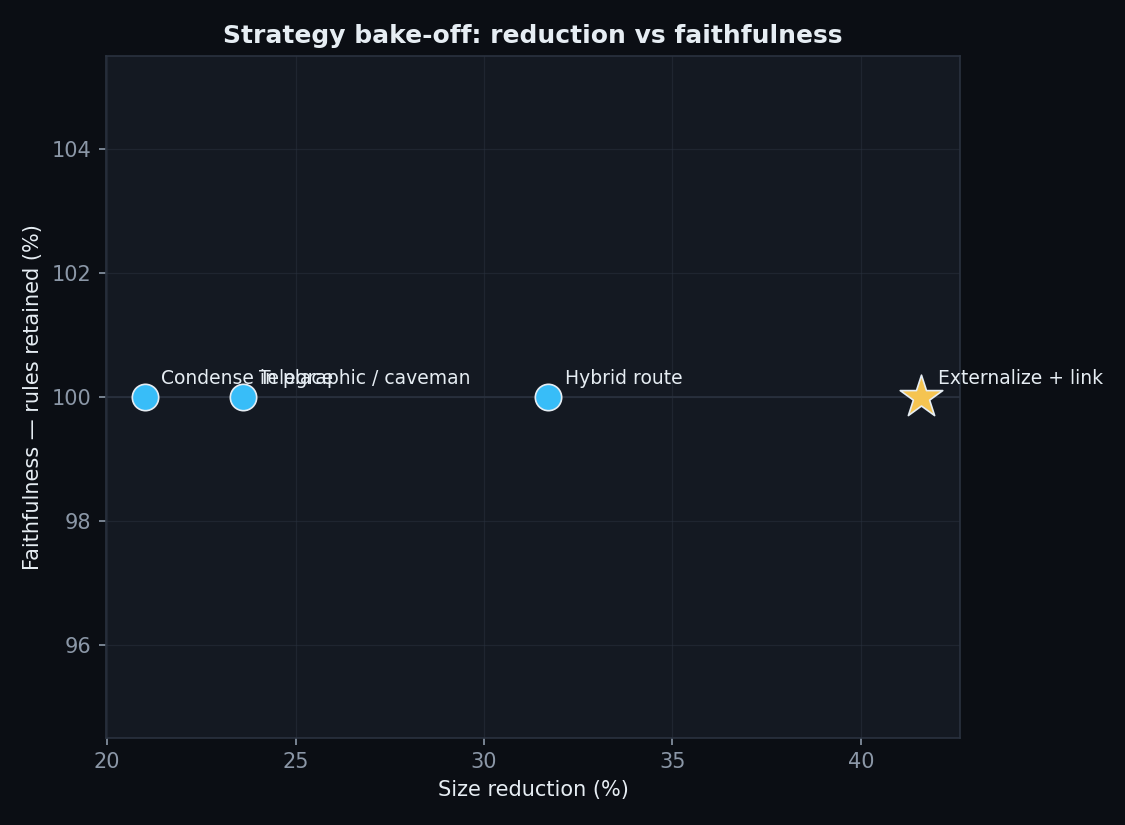
| Strategy | After (chars) | Reduction | Faithfulness | New files | Verdict |
|---|---|---|---|---|---|
| Externalize + link ★ | 29,040 | −41.6% | 100% | 5 | WINNER |
| Hybrid route | 33,916 | −31.7% | 100% | 3 | qualified |
| Telegraphic / caveman | 37,949 | −23.6% | 100% | 0 | qualified |
| Condense in place | 39,266 | −21.0% | 100% | 0 | qualified |
Winner selection: all four candidates qualified (under the hard limit, no load-bearing rule lost) and all scored 100% faithfulness, so the tie-break — larger reduction — decided it. Externalize + link wins decisively: it is the only candidate to also clear the soft 34k target with room to spare, because moving whole playbooks out of the file beats compressing them in place.
Trade-off disclosed: externalization reduces in-context size, not total-corpus size — the
detail is one hop away in a linked file, not deleted. This is the right trade for a harness char
budget (only CLAUDE.md counts against the limit; linked files are read on demand), and it mirrors
the repo’s existing docs/agents/ pattern (issue-tracker.md, triage-labels.md, domain.md).
5. Finding: the phantom-rule artifact (a validity lesson)
As-run, the workflow disqualified all four candidates and returned no winner. Every candidate
“missing” the same three rules with identical counts:
docs-cli-help-regen, ci-deps-editable-install, badges-header-leave-alone.
That uniform signature was the tell. On inspection, none of the three exist in CLAUDE.md —
they are entries from the operator’s MEMORY.md auto-memory index (feedback_docs_drift.md,
feedback_ci_deps.md, feedback_badges_header.md), injected into the inventory agent’s context via
a <system-reminder> block and mistaken for file content. The inventory over-collected ambient
context: 127 extracted − 3 phantom = 124 real rules.
Against the true 124-rule inventory, every candidate is 100% faithful with zero load-bearing losses. This is a live instance of METHODOLOGY §5’s “inventory completeness” threat — the faithfulness score is only as trustworthy as the ground-truth list it is scored against.
Guards adopted for reruns:
- Scope the inventory agent to file bytes only — explicitly exclude injected
<system-reminder>/MEMORY.mdcontent from “the file.” - Treat a rule that all candidates “miss” identically as an inventory artifact until proven a real regression (a genuine compaction loss almost never lands on every strategy at once).
- Verify each flagged “missing” rule against a
grepof the original before disqualifying.
6. Reproducibility
This lab is designed to replay on a different context type (a .cursorrules, an AGENTS.md, a
raw system prompt, another repo’s CLAUDE.md). The full protocol — Phases A–E, the do-not-touch
re-scoping step, and the determinism note — is in
METHODOLOGY.md; the exact workflow script is preserved as
bakeoff.workflow.js (see WORKFLOW.md).
The inventory + scoring are the reproducible control: candidate wording varies run to run, but which rules must survive does not. For a strict replay, cache the winning candidate corpus and re-score it — report faithfulness (stable) and achieved reduction (run-specific) separately.
Artifacts
| Artifact | Path |
|---|---|
| Analyzer (pure-stdlib) | context_diet.py |
| Chart generator | make_charts.py |
| Before baseline | baseline.json (49,687 chars, 36 sections) |
| After baseline | after.json (29,040 chars, 33 sections) |
| Bake-off scores | bakeoff.json (4 candidates, corrected scoring + phantom-rule note) |
| Charts | charts/{size-before-after,section-histogram,bakeoff-scatter}.png |
| Workflow script (regenerates all 4 candidates) | bakeoff.workflow.js |
The four full candidate rewrites are not checked in here (each is a near-complete CLAUDE.md
variant belonging to the target repo). They are deterministically regenerated by re-running
bakeoff.workflow.js; the winning rewrite is the CLAUDE.md landed in the target repo’s trim PR.
The winning method is packaged as an installable Claude Code skill —
gaia-research/skill-context-diet — invokable
as /context-diet on any oversized agent-context file.
Privacy: every chart consumes only aggregate metrics (char counts, faithfulness %, section sizes). No contributor handles, incident text, or private paths appear in any figure.